Street food prices by country fall into four rough bands: about 1 to 3 USD for a single dish in much of South and Southeast Asia, 3 to 6 USD across Latin America, North Africa and West Africa, 6 to 12 USD in richer Asian and European countries, and 10 to 20 USD in the most expensive markets. These are hedged ranges as of 2026, not quotes.
How these street food price bands were built
Exact prices for street food change with exchange rates, inflation, fuel costs and the day of the week, so a single figure for a country goes out of date quickly and misleads more than it helps. This guide uses bands instead. A band is a range in US dollars for one standard street meal: a main dish, such as a noodle bowl, a plate of rice with a stew, a couple of tacos or a flatbread with a filling, without drinks.
Countries are placed in a band by how their street meals usually compare, from general knowledge of the cost of eating out. Many countries straddle two bands, and a capital can sit one band above the rest of the country. Treat every band as a starting expectation and not as a price list. The seven sections after the table explain what pushes a stall up or down a band, and the last section tells you how to check before you eat.
Street food price bands for 20 countries
| Band | Typical cost of one street meal (USD, as of 2026) | Countries where it often sits | What it usually buys |
|---|---|---|---|
| Band 1: low | About 1-3 | India, Vietnam, Indonesia, Thailand, Egypt | A noodle bowl, a plate of rice and curry, a filled flatbread or a rice dish with eggs |
| Band 2: moderate | About 3-6 | Mexico, Peru, Morocco, Ghana, Nigeria, Malaysia, Georgia | Tacos or a stew with rice, a grilled skewer plate, a sandwich with salad and sauce |
| Band 3: higher | About 6-12 | Japan, South Korea, Taiwan, Portugal, Italy, Greece, Turkey | A rice or noodle set, a stuffed flatbread, a sandwich or fried snack with a drink |
| Band 4: high | About 10-20 | United States, Australia, United Kingdom | A food-truck plate, a loaded sandwich or a market lunch |
Taiwan, Turkey and Malaysia are often cheaper than their placement suggests, and big cities in Mexico, Peru and Morocco can sit a band higher than small towns. The bands are a guide to scale, and street food prices by country should always be read that way: as a rough order of magnitude, never a promise.
Seven things that move a street meal from one band to the next
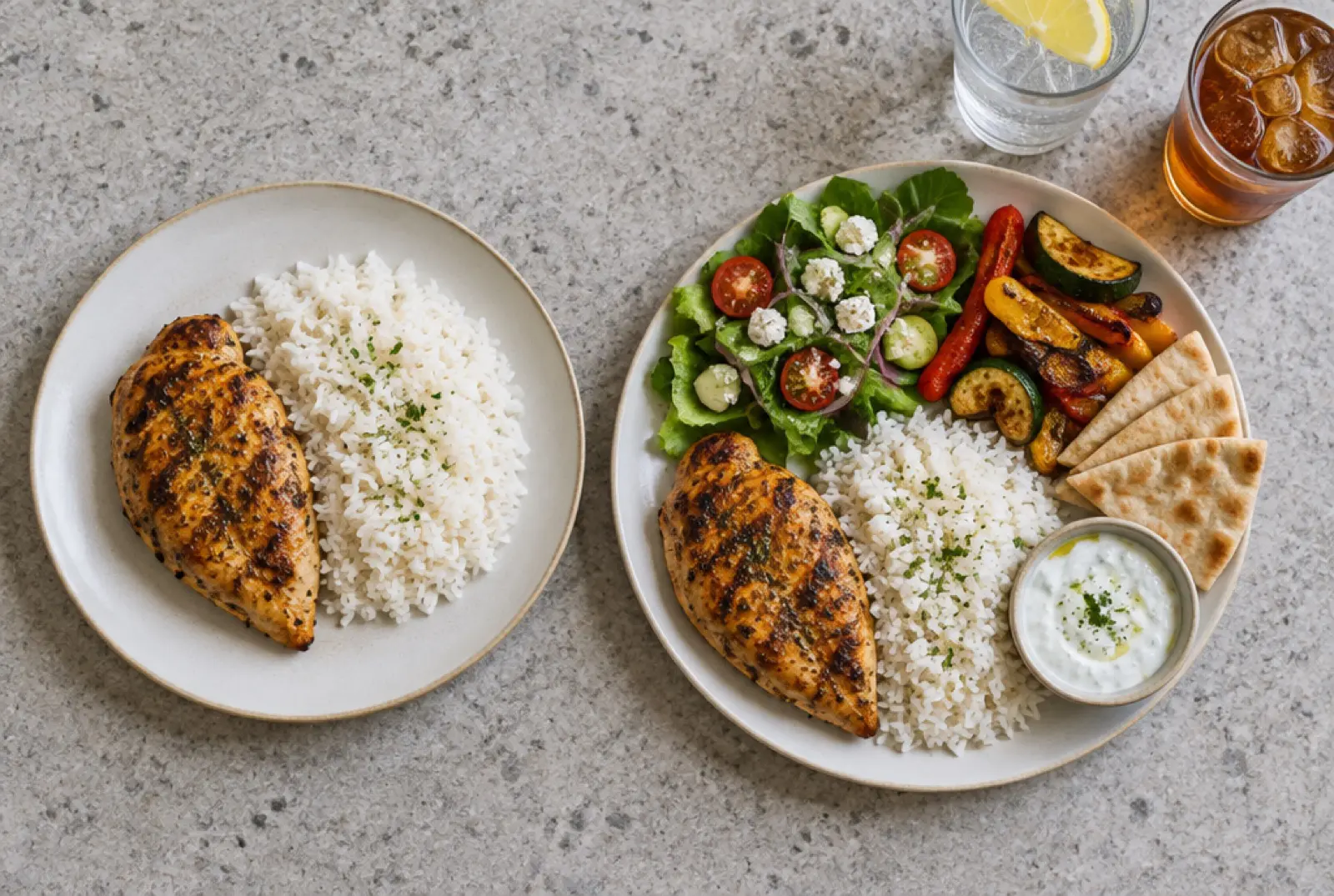
1. Whether the stall serves locals or visitors
The biggest single factor is the customer. A stall beside a landmark, a station exit or a cruise terminal prices for people who will not come back. A stall two streets away, with workers on a break, prices for regulars. The gap between the two can be a full band. Walk away from the main tourist route and the same dish can drop to the lower end of the range.
A useful test is to count the people who look like regulars. If you see more than a handful, the price is probably fair. If you see only visitors, ask the price before you order.
2. The time of day
Breakfast dishes are usually the cheapest food on the street, because they are simple and sold in volume to people on their way to work. Lunch is mid-range, and evening stalls aimed at nightlife or tourists cost more. A night market snack can cost less than a sit-down meal but often costs more than the same item at breakfast. Where the main meal is at lunch, the lunch plate is often the best value of the day.
3. Portion size and the main ingredient
Rice, noodles, flatbread, beans and potatoes make cheap meals. Beef, lamb, prawns, crab and whole fish move a dish up. The same rice plate can cost twice as much with a different protein. If you are watching your budget, order the dish the stall is known for and the protein most locally available, which is usually chicken, pork, fish or eggs depending on the country.
4. Currency swings and inflation
Prices in dollars shift when a currency weakens or strengthens, and local prices rise in countries with high inflation. A band that held a year ago can be stale today. Use these ranges as a first guess, then check a recent traveller report or an official tourism source for the current level, and convert at the rate your bank or card gives you.
5. How the stall is set up
A cart with no seating, a stall with stools and a counter, and a covered food hall with tables charge differently. Rent, licensing and service raise the price as the set-up gets more formal. A stand-up snack is the cheapest way to eat. Some food halls add a service charge or sell through ordering screens, so check how it works before you sit down.
6. Drinks and extras
A dish can look cheap until you add a drink, a side or a sauce. Bottled water, soft drinks and beer are often a large share of the bill in countries with a low food band. In some places tea or water comes free with the meal, and in others a refill is charged. Ask what is included, and note that a dish served with several small side plates may cost more than a stand-alone dish.
7. Location inside the country
Capitals, island resorts and airport areas charge more than provincial towns, even for the same dish. Coastal cities in countries with a strong tourism trade can sit a band above inland ones. A long distance from the origin of the main ingredient also shows up in price: fresh fish is cheaper near the harbour, and mountain dishes cost less in the mountains.
Common mistakes when budgeting for street food
The first mistake is to take a headline figure from a blog post and multiply by the number of meals. Prices vary within a country by a factor of two or three, and the figure may be several years old. Even a well-researched table of street food prices by country cannot tell you what a stall near your hotel charges this week. The second is to confuse street food with cheap food. In several countries, street meals are excellent value, but in others the same stall competes with restaurants and charges accordingly.
The third is to forget the unit. A price may be for a single skewer, a portion, a plate or a kilo, and many markets quote per piece. Ask whether the figure is per item or per plate. The fourth is exchanging money at a poor rate and then judging prices through it. Pay in local currency at a fair rate, and keep small notes for stalls.
Tipping is another gap. Many street stalls do not expect a tip, but some do round up the bill, so watch what the locals do.
What to verify before you rely on these bands
Every number in this guide is a general guide to street food prices by country, and none is a quote. Before you plan a budget around it, verify these things:
- Current exchange rate. Use your bank or a reputable converter, and check again close to departure.
- Recent local prices. A tourism board, city market page or recent traveller report is better than any fixed table.
- Inflation. Countries with fast price rises can move a full band in a year or two.
- Per-item or per-plate pricing. Ask before you order.
- Food-safety advice. Check your national travel-health service for the destination, since a low price is not a reason to eat anything.
Where to go next: price bands in the food guides
These place-level guides give price bands for single destinations, with market timing and the dishes that make the bands worth reading.
- Grenada Food: What to Eat, Spice Markets and Price Bands covers an island economy where imports shape the bill.
- Accra Food Guide: Market Timing, Breakfast Dishes and Price Bands sets breakfast and supper side by side.
- Arequipa Food: Picanterías, Rocoto and Lunch as the Main Meal shows how a fixed lunch changes the budget.
- Kagoshima Food: Black Pork, Shochu and Morning Markets shows what a regional ingredient does to the price.
- Tucson Food: How a Desert City Became a UNESCO City of Gastronomy is a US city guide, useful for comparing against the Asian and Latin American bands.
FAQ about street food prices
Which country has the cheapest street food?
India, Vietnam, Indonesia and Thailand are often cited for low street prices, with a single dish commonly in the 1 to 3 USD range, but the answer shifts with exchange rates and city. Egypt and parts of South Asia are also low. Check recent local prices before you budget.
How much should I budget for street food per day?
Take the band for your country, multiply by the meals you plan to eat on the street, and add a margin for drinks and snacks. In a band 1 country, three street meals can stay low, while in a band 4 country they may match restaurant prices. Add 20 to 30 percent as a buffer.
Is street food always cheaper than restaurants?
Not always. In Asia, Latin America and parts of Africa, it is usually cheaper. In the United States, Australia and the United Kingdom, a food-truck meal can cost about the same as a casual restaurant plate. The quality can be higher, but the saving is not guaranteed.
Do street vendors accept cards?
Many do not, especially in lower-price bands. Cash in small notes is the safe default, though some countries now use QR or mobile payments that foreign cards cannot use. Check whether a stall takes cards before you order, and keep local currency on hand.
Should I tip at street food stalls?
Usually not, and in some countries tipping at a stall is unusual. Rounding up the bill or leaving small change is welcome in some places. Watch what local customers do, and see local etiquette in the country guide before you decide.