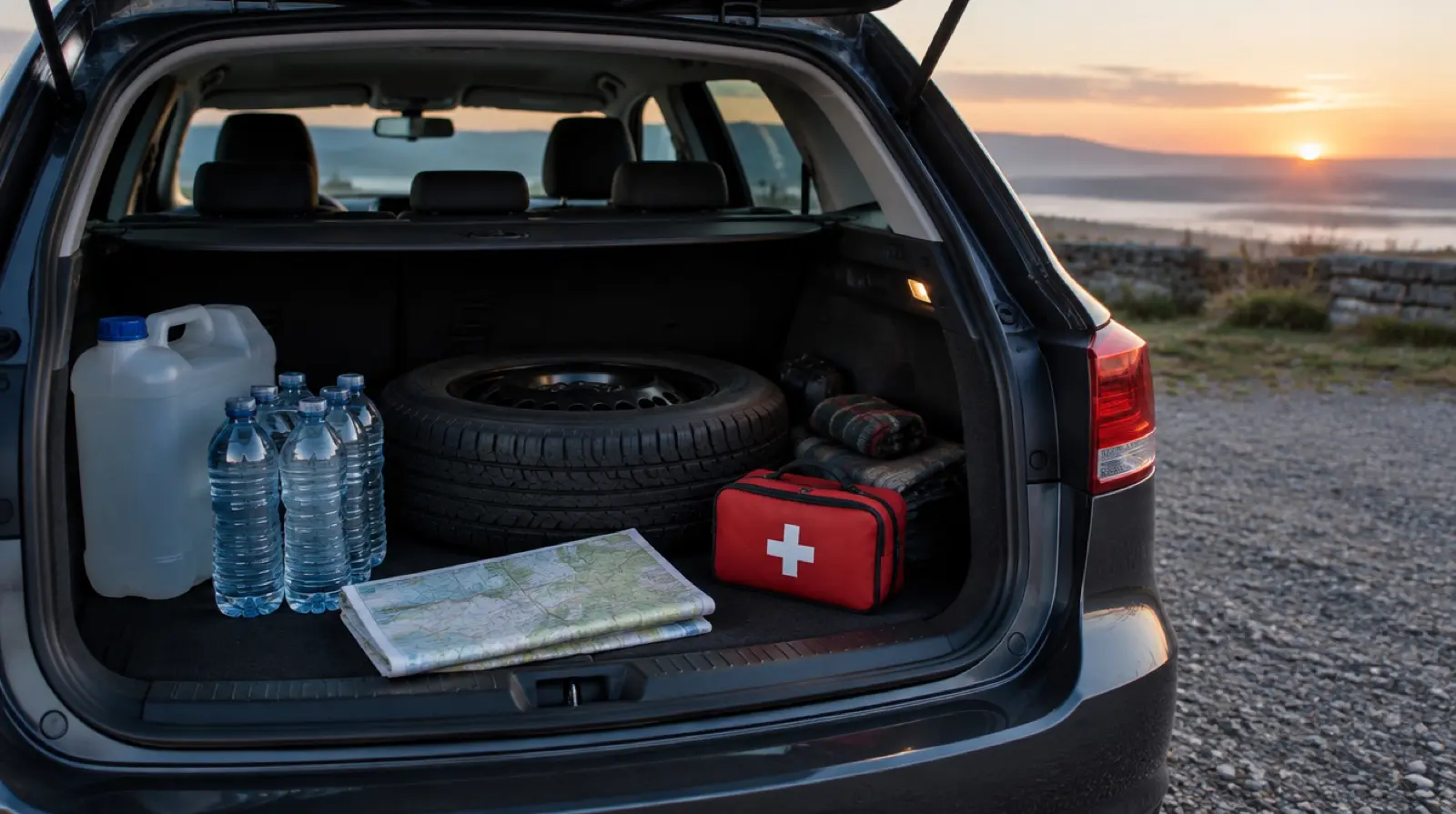
Road trip essentials come down to seven things: enough fuel for the longest gap between stations, water for the people and the car, offline maps, a sound spare tyre and tools, the right documents and insurance, a way to call for help and a buffer for anything you cannot control. Everything else is comfort. Below is a method, a table and seven items you can check off, with a fallback for each, written for remote roads rather than motorways.
How to choose road trip essentials
Pack for failure, not for the plan. Ask three questions for every route. How far is the longest stretch without fuel, water, phone signal or a repair shop? How long would help take to reach you? And what do you do if the road, a ferry or a border is closed? Your answers decide what you carry. A day trip near a city needs little. A desert, mountain or island route needs a lot more.
Rank each item by consequence, not convenience. A missing phone charger is annoying. A missing spare tyre in a place with no signal is a night in the car. Sort the kit into three tiers: things that keep you alive, things that keep you moving and things that make the day pleasant. Fill the first two tiers completely before the third.
The road trip checklist at a glance
Quantities are starting points. Adjust for climate, distance from services and the number of people.
| Item | Rule of thumb | Why it matters | Fallback |
|---|---|---|---|
| Fuel | Refuel at half a tank in remote areas | Stations can be 100 to 300 km apart | Small fuel can where legal; know the nearest station |
| Water | 3 to 4 litres per person per day, plus a car reserve | Heat and breakdowns multiply the need | Purification tablets or a filter |
| Offline maps | Download the whole region before you leave | Signal fails first where you need it | Paper map or road atlas |
| Tyres and tools | Check pressure, tread and the spare; know how to change it | Punctures are the commonest fault | Repair kit and a compressor |
| Documents | Licence, passport, registration, insurance, rental terms | Border and rental rules vary | Paper and cloud copies |
| Safety and comms | First-aid kit, torch, warm layer, charged power bank | A delay can turn into a night out | Satellite messenger for no-signal routes |
| Time buffer | One spare day per big transfer or ferry | Weather and closures cause most missed plans | A shorter alternate route |
The seven items in detail
1. Fuel and range
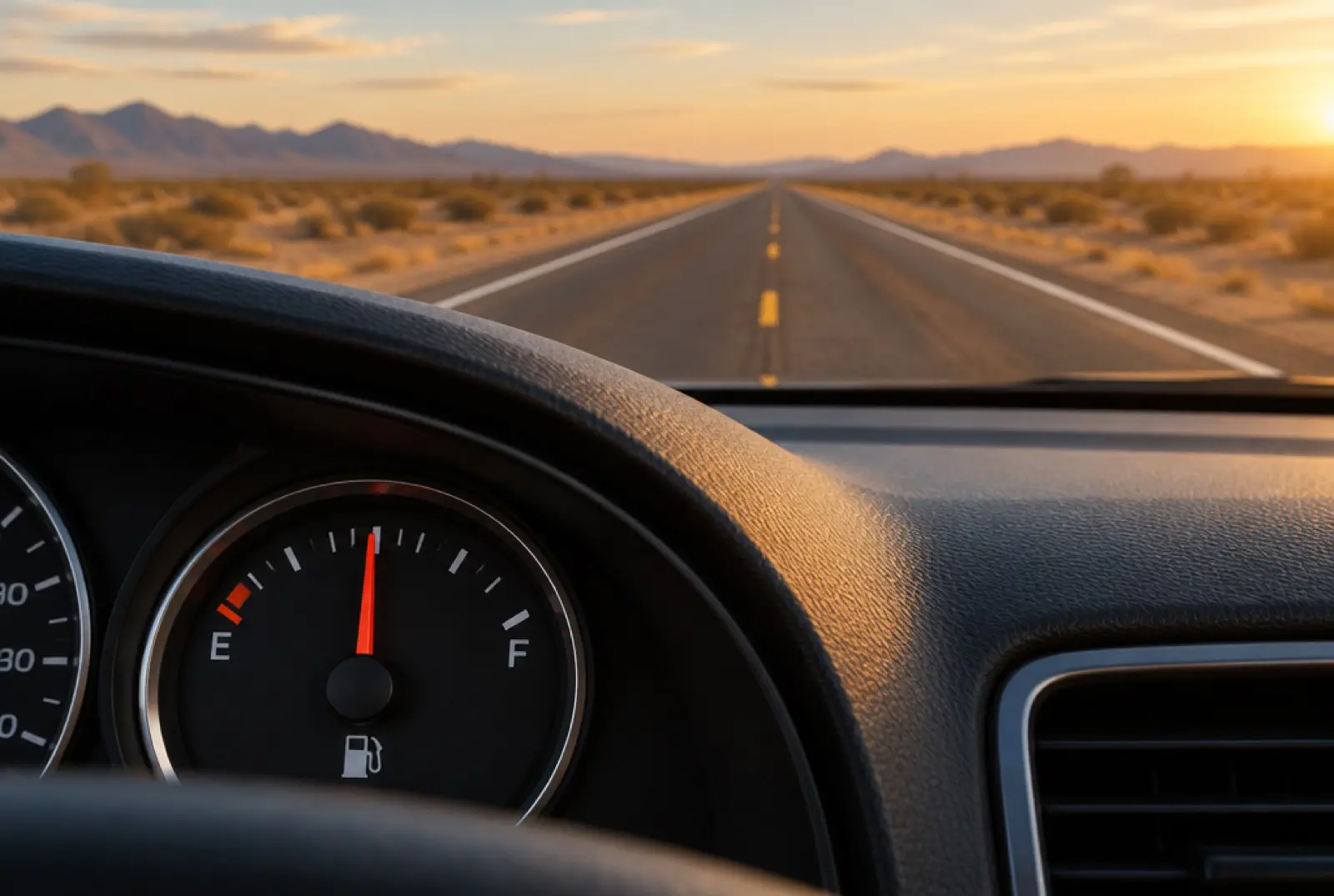
Know your real range, not the number on the dashboard. In remote country, treat half a tank as the signal to refuel at the next station, even if the next one seems close. Do not rely on a station being open at night or on a card machine working. Carry cash for small stations. Check whether the fuel type fits: some regions sell mainly diesel, others petrol, and a wrong-fuel mistake can wreck an engine. In extreme areas, an approved spare container adds margin, where the law allows it.
2. Water and food
Plan on 3 to 4 litres per person per day, and more in hot, dry country. In desert routes, carry an extra reserve in the vehicle, since a cooling fault or a stuck car turns hours into a day. Keep non-perishable food that needs no cooking: nuts, bars, tinned fish and fruit. Electrolyte tablets help in heat. If you must walk for help, stay with the vehicle unless you are certain of a nearby road, because a car is easier to find than a person.
3. Offline maps and navigation
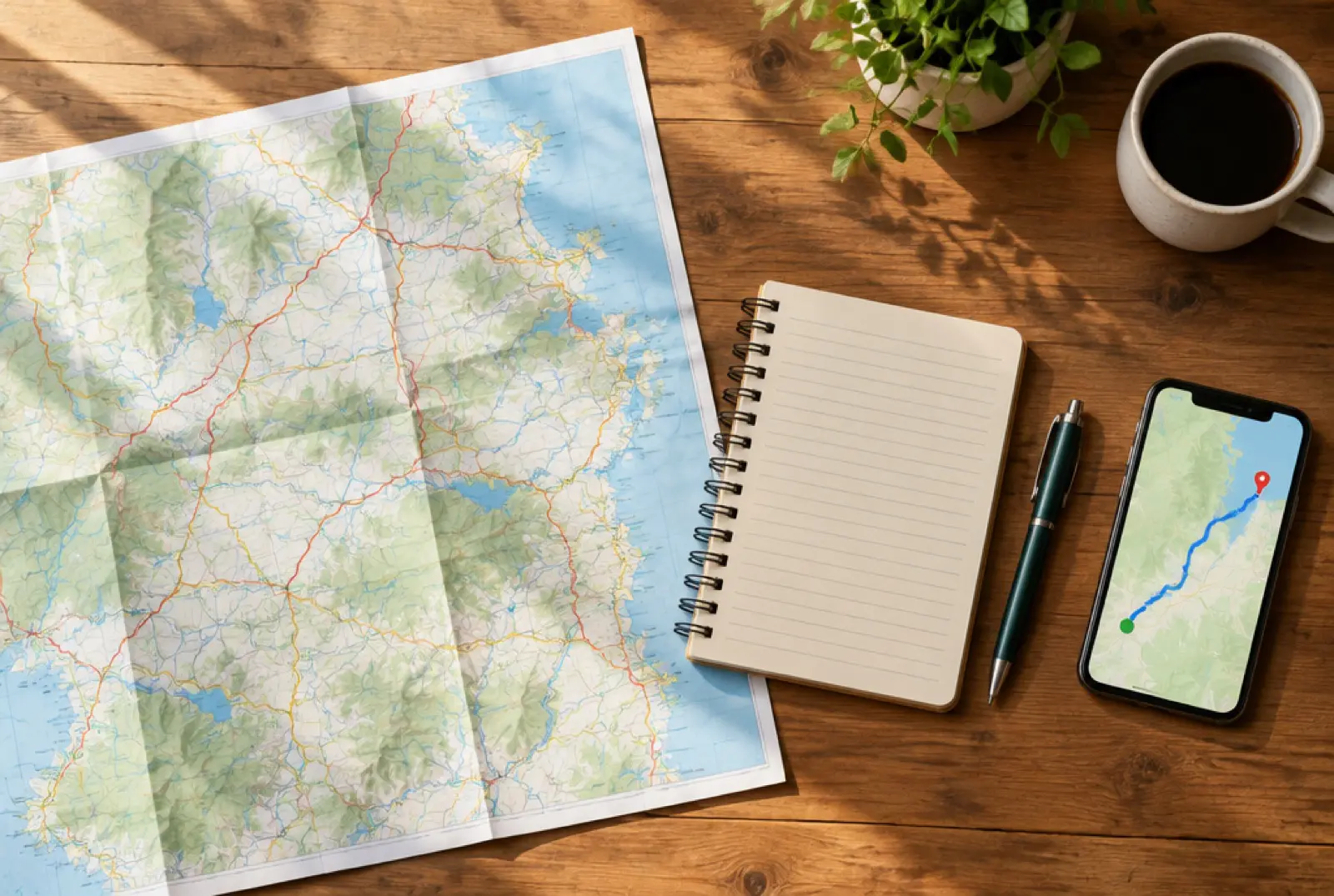
Download maps for the whole region on at least two apps, and a paper map as the third layer. Phones lose signal, overheat on a dash in summer and run out of battery. Mount the phone in the shade and use a car charger. Before you leave, check the road status with the local highway or park authority, since mountain passes and park roads close for snow, rock fall or fire. Treat route times from an app as the best case.
4. Tyres, spare and basic tools
Check tyre pressure when the tyres are cold, and look at the tread and sidewalls. Confirm the spare is inflated and that you have the jack and wheel brace, and that you know where they are. A rental car may come with a repair foam rather than a spare, which handles little. A 12-volt compressor, jump leads and a tow strap are small and cheap. Learn to change a wheel on a flat, dry surface before you need to do it at night.
5. Documents, insurance and rental terms
Carry your driving licence and, where required, an international driving permit, plus your passport, vehicle registration and proof of insurance. Check whether your rental allows gravel roads, ferries or border crossings, because many contracts exclude them and void cover if you ignore the clause. Photograph every document and keep a copy in cloud storage. Rules and fees change, so check the official source for each country.
6. Safety kit and communication
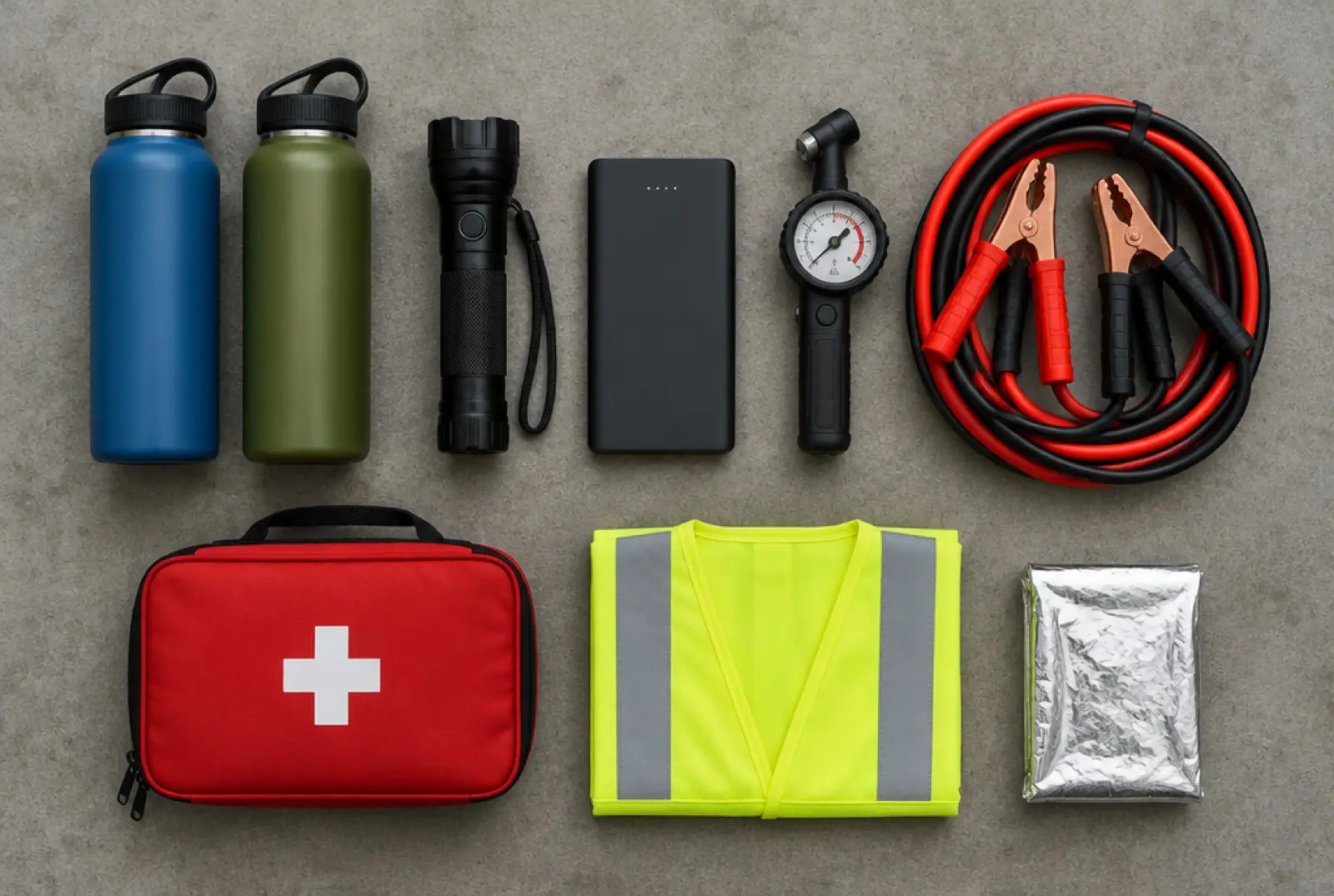
A first-aid kit, a torch with spare batteries, a warm layer, a blanket and a basic rain jacket live in the car all year. A power bank keeps the phone alive. For routes with no coverage, a satellite messenger is the best single purchase, and a trip plan left with someone at home is the cheapest. Know the local emergency number, which is not 911 everywhere. Do not drive tired: it is a larger risk than most mechanical faults.
7. A time buffer and a second plan
Add one spare day around any ferry, mountain pass or border. Ferries are cancelled for wind and fog, and passes close with little warning. Check the detail on the specific crossing, for example the Port Angeles to Victoria ferry, where weather and maintenance both cause gaps. Book accommodation with free cancellation when you can, and decide in advance what you drop first if you are two hours late.
Road trip essentials by terrain
- Desert: 4 litres of water per person per day, a sun shade for the windscreen, a start before 7 a.m. and a rule never to leave tarmac without a second vehicle or a satellite messenger.
- Mountains: chains or winter tyres where required, a full tank before every long climb and a warm layer for each person, since a closed pass can mean 3 to 6 hours stationary.
- Islands and coasts: a ferry plan with a spare day, a rain layer and a check of the last sailing of the day.
- Gravel and rural roads: two proper spares if the car allows, reduced speed of 40 to 60 km/h and the next fuel stop noted before you leave town.
Common road trip mistakes and edge cases
- Trusting the app’s drive time. Heat, traffic, roadworks and photo stops add 20 to 40 per cent on remote routes.
- Driving after dark in wildlife country. Animals on the road cause serious crashes in many regions, so finish before dusk.
- Ignoring altitude. Engines lose power and people feel unwell on high passes. Plan acclimatisation if you drive from sea level to 3,000 m or more.
- Overpacking the first day. A long first day on little sleep is a common cause of mistakes.
- Leaving valuables in sight. Remove bags from the seats at stops, particularly at trailheads.
- Assuming rental cover includes everything. Windscreen, tyres, underbody and gravel damage are often excluded.
What to verify before you rely on it
Check these within 48 hours of departure, from official sources, not from old forum posts or a blog.
- Road, pass and park-road status, plus any fire or flood closures.
- Ferry timetables and the operator’s cancellation policy.
- The current rules on documents, insurance and permitted routes in your rental contract.
- Weather for the route, not just the destination, including wind and heat warnings.
- Fuel availability in the least-served stretch. Phone a station or ask at the last town if you are unsure.
Where to go next
These guides apply the checklist to real places. For desert heat and trailhead parking, read the best hikes in Sedona guide. For canyon country, the best hikes in Zion guide covers shuttle and heat rules. For mountain parks and long distances, see the Jasper National Park guide. To choose where to drive, start with road trip ideas.
FAQ about road trip essentials
What are the most important road trip essentials?
Fuel, water, a working spare tyre, offline maps, valid documents and a way to call for help. These cover the failures that actually strand people. Snacks, playlists and chargers are useful, but only after the basics are sorted. Adjust the amounts to the distance between services.
How much water should you carry on a road trip?
Plan for 3 to 4 litres per person per day, plus a reserve in the car for remote or hot routes. Carry more in desert regions or when the next town is more than a few hours away. Water is the one item where overpacking costs almost nothing.
Do you need a spare tyre for a road trip?
On remote or gravel roads, yes: a full-size spare and the tools to fit it. Many modern cars and rentals have only repair foam, which fails on sidewall damage. Check what your vehicle has before you leave, and ask the rental company for a proper spare if the route is rough.
Should you download offline maps for a road trip?
Yes. Download the whole region before departure, on more than one app if you can, and carry a paper map for remote areas. Coverage often drops in valleys, parks and mountain passes, which are the places where you most need directions.
How much buffer time should you plan on a road trip?
One spare day for each ferry, border, mountain pass or fixed booking is a sound rule. Route times from an app are the best case, so add 20 to 40 per cent on remote roads. Free-cancellation lodging gives you room to move.