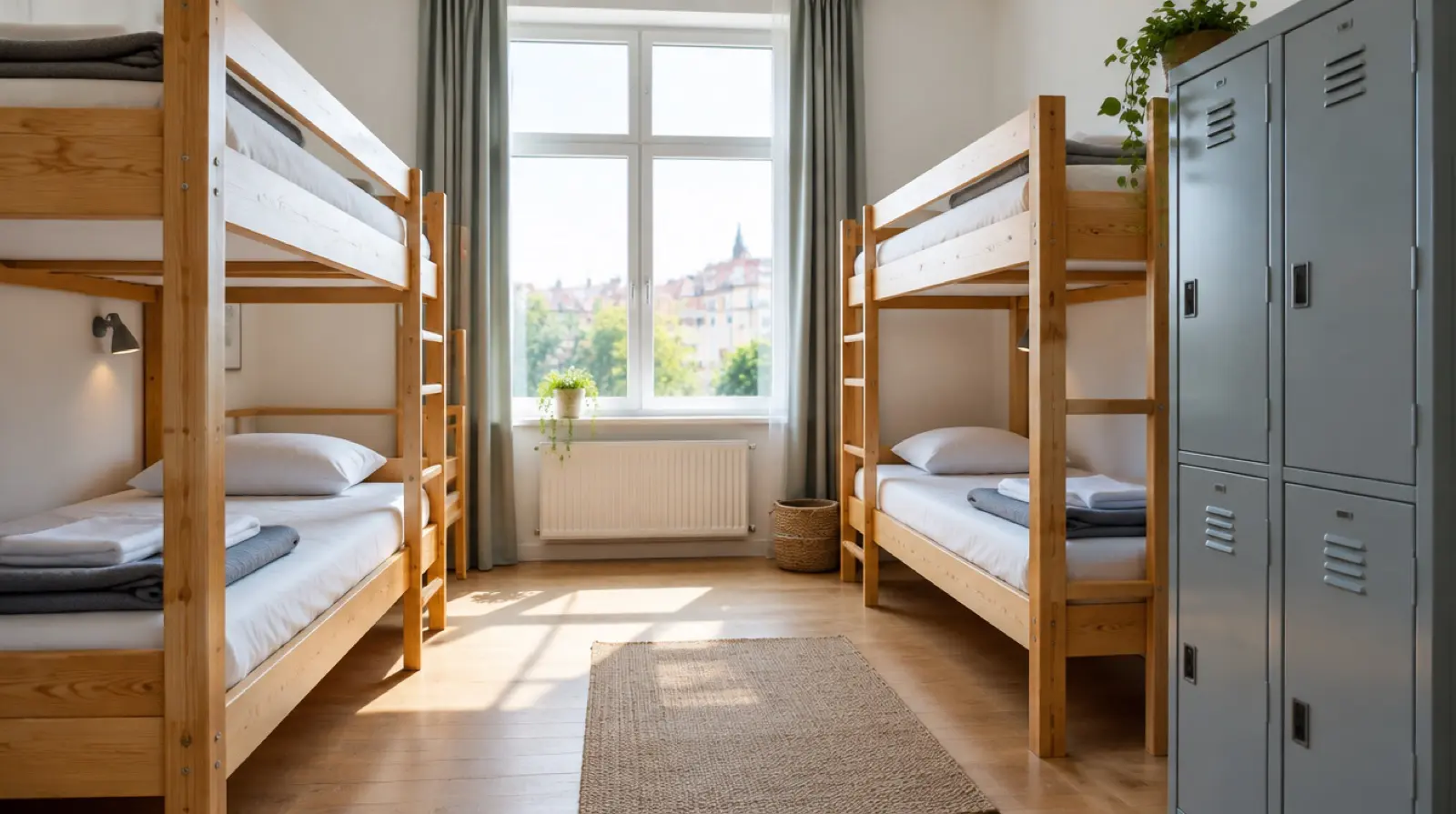
What is a hostel? It is budget accommodation where you rent a bed, not a whole room, and share bathrooms, a kitchen and a common room with other guests. Most also sell private rooms. For solo travelers the appeal is low cost and built-in company. Below: how dorms work, what to check before you book, and the habits that make a stay comfortable.
What is a hostel, and how does it differ from a hotel?
A hostel is built around shared space. You book a single bed in a dorm of anywhere from three to twelve or more beds, or a private room with shared or en-suite bathroom. The price per person is usually much lower than a hotel room, and the extras are communal: a kitchen, a lounge, a rooftop or courtyard, and often events such as dinners or walking tours.
A hotel sells privacy and service. A hostel sells price and company. Neither is better by default. The right one depends on your budget, how much you want to meet people and how well you sleep around strangers. For the longer comparison, see our guide to hostel vs hotel for solo travelers.
Hostel room types compared
| Room type | Typical price (hedged) | Privacy | Social level | Best for |
|---|---|---|---|---|
| Large mixed dorm (8 to 12 beds) | Lowest | Low | High | Tight budgets, easy sleepers |
| Small mixed dorm (4 to 6 beds) | Low | Low to medium | Medium to high | Most first-timers |
| Female-only dorm | Low to mid | Medium | Medium | Comfort and quiet |
| Capsule or pod bed | Low to mid | Medium | Low to medium | Light sleepers, tech users |
| Private room | Mid | High | Medium, via common areas | Longer stays, privacy |
Prices vary widely by city and season, so compare your actual dates. As a rough guide for 2026, a dorm bed ranges from about 10 to 25 USD in cheaper regions to 30 to 60 USD or more in expensive capitals. A city like Tokyo or London costs far more than a beach town in Southeast Asia, even for the same bed.
Seven things to know before you book a hostel
1. Pick the neighbourhood before the hostel
A great hostel in a bad location costs you in late taxis and lonely walks. Look for a central, well-lit area with restaurants and a transit stop within a short walk. For city-specific advice, see where to stay in London, where to stay in Paris or where to stay in Tokyo.

2. Read reviews for security, not only cleanliness
Filter recent reviews for words such as locker, key card, night staff and female dorm. A staffed reception around the clock is a good sign. Look at the lowest-scoring reviews and see whether the complaints are about noise, which is normal in dorms, or about safety, which is a reason to move on.
3. Choose a smaller dorm and a lower bunk
A four or six-bed room is quieter and easier to read than a twelve-bed one. Take a lower bunk if you can, so you are not climbing in the dark. Many hostels let you note a bed preference at booking, or you can ask at check-in.
4. Use a female-only dorm if you want one
Many hostels offer female-only rooms, sometimes with their own bathroom. They are often the same price as a mixed dorm or slightly more. They are not required, and plenty of solo women are happy in mixed rooms, but they are a good first choice if you are nervous about sharing.
5. Bring a small kit
A padlock for the locker, earplugs, a sleep mask, a quick-dry towel (some hostels charge for towels) and a small torch or phone light cover most problems. Flip-flops for shared showers are useful. Keep your passport, phone and cards in a locker or on you, never loose on the bed.
6. Use the common room on night one
The easiest way to meet people is to show up where they are. Spend an hour or two in the lounge, join the family dinner or sign up for the free walking tour. Ask a simple question, such as “Where are you heading next?” It is a low-pressure way to find company, and you can leave when you want.
7. Plan for the first night and for arriving late
Arrival card: check the reception hours and the door policy before you land. If reception closes at night, message ahead for a late check-in code. A daytime arrival, by around 6pm, is ideal. If you land late, take a taxi or ride-hail to the door, not a night bus with a long walk at the end. Screenshot the address and check-in details so you are not searching with a low battery.
How to meet people in a hostel without pressure
Part of knowing what is a hostel is knowing the social side is optional. If you want company, start small: a shared kitchen at dinner time, the free tour or a board game evening. These give you a reason to talk and an easy way out. If you want quiet, take a private room or a female dorm and use the common room only when you feel like it.
Boundary scripts help in shared spaces. They work because they are short, polite and need no justification:
- “I’m going to turn in, see you tomorrow.” Ends a late night.
- “I’d rather not share my room number.” Fine for anyone who asks.
- “Can I ask you to keep it down? I’m trying to sleep.” Reasonable at any hour; if it does not work, go to reception.
- “No, thank you, I’m going to stay in.” Declines a bar invitation with no apology.
A sample first evening in a hostel
If you arrive around 5pm, here is a simple pattern that works. Check in, choose your bed, set up the locker and take a quick look at the common room and kitchen so you know where they are. Walk the immediate block for ten minutes while there is still light, and note the nearest station, pharmacy and late shop.

By 7pm, around two hours after check-in, go back and join the group dinner or sit in the lounge. Ask one or two people for tips on the next day. By 9 or 10pm you can head to bed, or go to a hostel event if you want one. This gives you an early orientation, a first contact and an early night, and it is better than arriving at midnight and sleeping badly.
What to do after dark in a hostel
Many hostels organise evening events: pub crawls, cooking nights, film nights, quizzes or rooftop dinners. Go to the ones that suit you, and skip the rest. If you go out with a group, agree on how you will get home and who you will go home with, and keep your own phone charged and your own ride sorted. Check the door policy and the key card before you leave. If you stay in, a quiet common room, a kitchen dinner or an early night is a perfectly good evening.

Common hostel mistakes and edge cases
The most common mistake, and a costly one, is booking the cheapest bed in the biggest dorm. You save a few pounds or dollars and spend the night with light, noise and strangers coming and going. Step up to a smaller room if you can.
Another is assuming every hostel is a party hostel. Some are quiet and calm, some are sociable, some are loud. Read the listing and reviews for words like “social”, “quiet” and “party”.
A third is leaving valuables out. Even in a good hostel, theft is usually opportunistic, so use the locker every time. Edge cases: age limits (some places cap age or restrict dorm bookings for under-18s), curfews or lockouts in a few countries, and extra charges for sheets, towels or lockers. Read the house rules before you pay. A final edge case is party-heavy locations: a hostel with a bar on site can be loud until 2 or 3am, so if you need sleep, choose a place without one or ask for a room far from the common area.
What to verify before you rely on a hostel
Before you commit to your idea of what is a hostel, confirm the cancellation policy, the check-in window and the final total, including city taxes and fees. Check whether the dorm is mixed or female-only, and whether the bathroom is shared. Read the last three months of reviews, not the top ones. Look at the map to see the real walking distance to a station: under 10 minutes is a good target, and under 5 is better at night. Save the address and phone number offline, and tell someone at home where you are staying.
Where to go next
If you are choosing a city for your first hostel stay, our ranking of the best places to travel solo compares arrival ease, night transit and social options. Also see the area guides for Lisbon and Barcelona.
What is a hostel FAQ
Are hostels safe for solo female travelers?
Many solo women stay in hostels and have good experiences. Choose a hostel with recent reviews that mention security, lockers and night staff, take a lower bunk in a small or female-only dorm, and use the locker for your valuables. Trust your instincts and ask for a different room if something feels off.
Do you have to share a room in a hostel?
No. Most hostels also offer private rooms, with shared or en-suite bathrooms. They cost more than a dorm bed but usually less than a hotel. You still share the kitchen and common areas, so it is a good middle option if you want company without sharing your sleeping space.
How much does a hostel cost?
It varies by country, city and season. Dorm beds are often a fraction of a hotel room, from low prices in parts of Southeast Asia and Latin America to much higher in London, Paris, Tokyo or Scandinavia. Compare your dates and check for taxes, linen or locker fees before you book.
What is the difference between a hostel and a hotel?
A hostel sells beds and shared space, usually in dorms, at a lower price per person. A hotel sells private rooms with more service and more privacy. Hostels have common rooms, kitchens and social events, while hotels usually have a reception, room service and no shared bedrooms.
Do hostels have age limits?
Some do. A few restrict dorm beds to adults over 18, and some cap age for certain rooms or events, but most welcome all adults and many have no upper limit. Check the listing and house rules before you book, particularly for youth hostel brands, which often have different policies by country.