Jet lag with kids usually eases within a few days if you shift meals, light and bedtime toward local time in small steps. Most primary-school children adapt at roughly a day per hour of time difference, sometimes faster. Plan a light first day, use morning daylight as the main anchor, and expect one or two rough evenings.
The short version
- For gaps of three hours or more, start shifting bedtime and meals a little before you leave, or skip the pre-shift for short trips.
- On arrival, follow local meal times and get outdoors in daylight, as early as the children can manage.
- Keep the first day empty: one anchor outing, one rest, one early evening.
- Hold a fixed local bedtime, even if the first night starts slowly.
Step by step
1. Decide whether to pre-shift at home
This is the first decision point. For a gap of one or two hours, most families do nothing at all. For gaps of five hours or more, moving bedtime and wake-up by 30 to 60 minutes a day for three or four days before departure can help, but only if school and routines allow it. Children who are already tired and unsettled by a pre-shift may arrive worse off, so keep it gentle or skip it.
2. Use the flight to start the shift
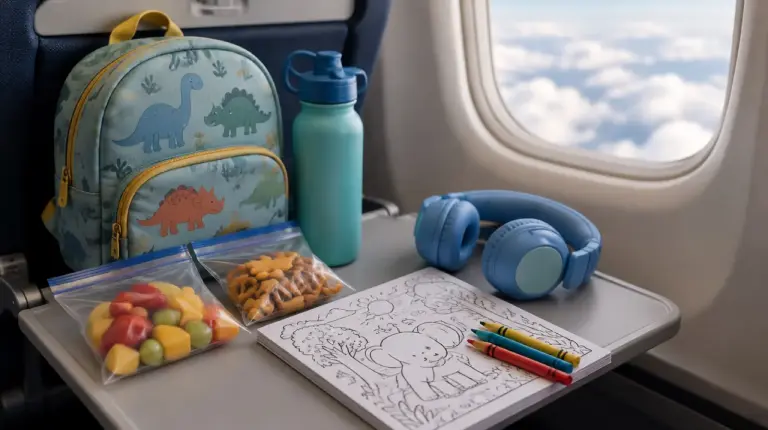
Set your watch to destination time at boarding and plan sleep and meals around it. If it is night at the destination when you land, encourage rest on the flight, with dim light, a blanket and quiet. If it is daytime on arrival, keep the children awake for the last part of the flight with a meal and a screen block. Read more about the journey itself in our guide to long travel days with kids.
3. Anchor the first day with light and meals
Daylight is the strongest signal for the body clock, and meals are the second. After landing, get the children outside for a walk, a playground or a park, ideally before noon. Serve breakfast, lunch and dinner at local times even if appetites are small. Keep an easy snack ready for the hours when children are hungry at odd times, and keep it light, because large meals late at night make sleep harder.

4. Handle the afternoon slump
Most children hit a wall between early afternoon and early evening in the first days. A short nap of 30 to 45 minutes is usually fine for the youngest primary-school children if they need it, but set an alarm so the nap does not run into bedtime. For older children, a quiet hour with a book or an audiobook may replace the nap. A rest anchor like this keeps the evening from collapsing.
5. Hold a firm bedtime
Aim for a local bedtime that is a little earlier than normal on the first night, then move toward the usual time over three to five days. Keep the routine familiar: bath, book, same pyjamas. Dim the lights an hour earlier, and keep screens out of the last 30 minutes. If a child wakes at 3 a.m. and is ready to play, keep the room dark and quiet, with no snacks and no screens, and settle again.

6. Plan what to cancel on day one
Treat the first day as a recovery day. Cancel timed tickets, early tours, long transfers and anything that needs good behaviour in a queue. Keep one outdoor block and one fixed meal. For a first full day in a new country, a plan like the one in our Japan itinerary with kids shows how to pace the opening days.
Shift plan by time-zone gap
These ranges are guides, not rules. Children differ, and eastward travel is usually harder than westward.
| Time-zone gap | Pre-shift at home | Typical settling time | First-day plan |
|---|---|---|---|
| 1 to 2 hours | None | 1 to 2 days | Normal day, earlier bedtime |
| 3 to 5 hours | Optional, 30 minutes a day | 3 to 4 days | One anchor outing, rest after lunch |
| 6 to 9 hours | Helpful if feasible | 4 to 7 days | Empty day, morning light, fixed dinner |
| 10 hours or more | Gentle, over 3 to 4 days | 5 to 8 days | Two light days, one block per day |
Age and stamina notes
Younger primary-school children, around 5 to 7, tend to crash earlier and wake earlier, so they need a firm rest block and an earlier bedtime. Children aged 8 to 12 cope better with a late first evening, but they may drift awake at night. Teenagers shift the other way, often staying up late and sleeping late. Whatever the age, the same sequence applies: daylight, meals, a short rest and a firm bedtime.
Tired-day fallback
If a child is flat on day two or three, drop to the fallback: a playground, a lunch in a quiet cafe, a rest hour back at the accommodation, an early dinner. Keep one fixed outing per day and nothing timed. A pool or a bath can reset a wound-up child. Resist adding an extra block to make up for lost time, because the loss is smaller than it feels.
Common mistakes
- Letting children sleep all afternoon, then wondering why bedtime fails.
- Filling the first two days with timed tickets, so any rough night costs money.
- Giving large meals late in the evening to a child whose body clock thinks it is lunchtime.
- Treating one bad night as a sign the plan has failed. Three of the first five nights are often uneven.
- Skipping daylight because of tiredness. A 30-minute walk does more than another hour in the room.
What to verify before you go
- Whether your child has a health condition that affects sleep or medicines. Ask a doctor or travel clinic before the trip; this guide does not cover dosing or treatment.
- The destination’s time-zone and daylight hours in your travel month. Sunrise and sunset change the plan more than people expect.
- Health advice for your destination, including fever and food-safety guidance, on the CDC travel health pages or your own government’s equivalent.
- Check-in times at your accommodation, since an early arrival may mean a long wait before a bed is ready.
FAQ about jet lag with kids
How long does jet lag last in children?
Often about one day per hour of time difference, though many children settle faster than adults. Eastward trips tend to take longer. A gradual shift, morning daylight and fixed meal times usually shorten the adjustment, but individual children vary.
Should I let my child nap on the first day?
A short nap of about 30 to 45 minutes is usually fine if the child is flat, as long as you set an alarm and finish it by mid-afternoon. A long nap late in the day often pushes bedtime back and makes the first night harder.
Can I give my child melatonin or sleep medicine?
Ask your doctor or travel clinic. Advice depends on age and health, and rules about availability differ by country. This guide does not give dosing. Many families rely first on daylight, meals and a steady bedtime routine.
Is it easier to fly east or west with children?
Westward is usually easier, because a later bedtime is more natural than an earlier one. Eastward trips often mean children are awake at night and sleepy in the morning. Allow an extra rest day for long eastward trips.