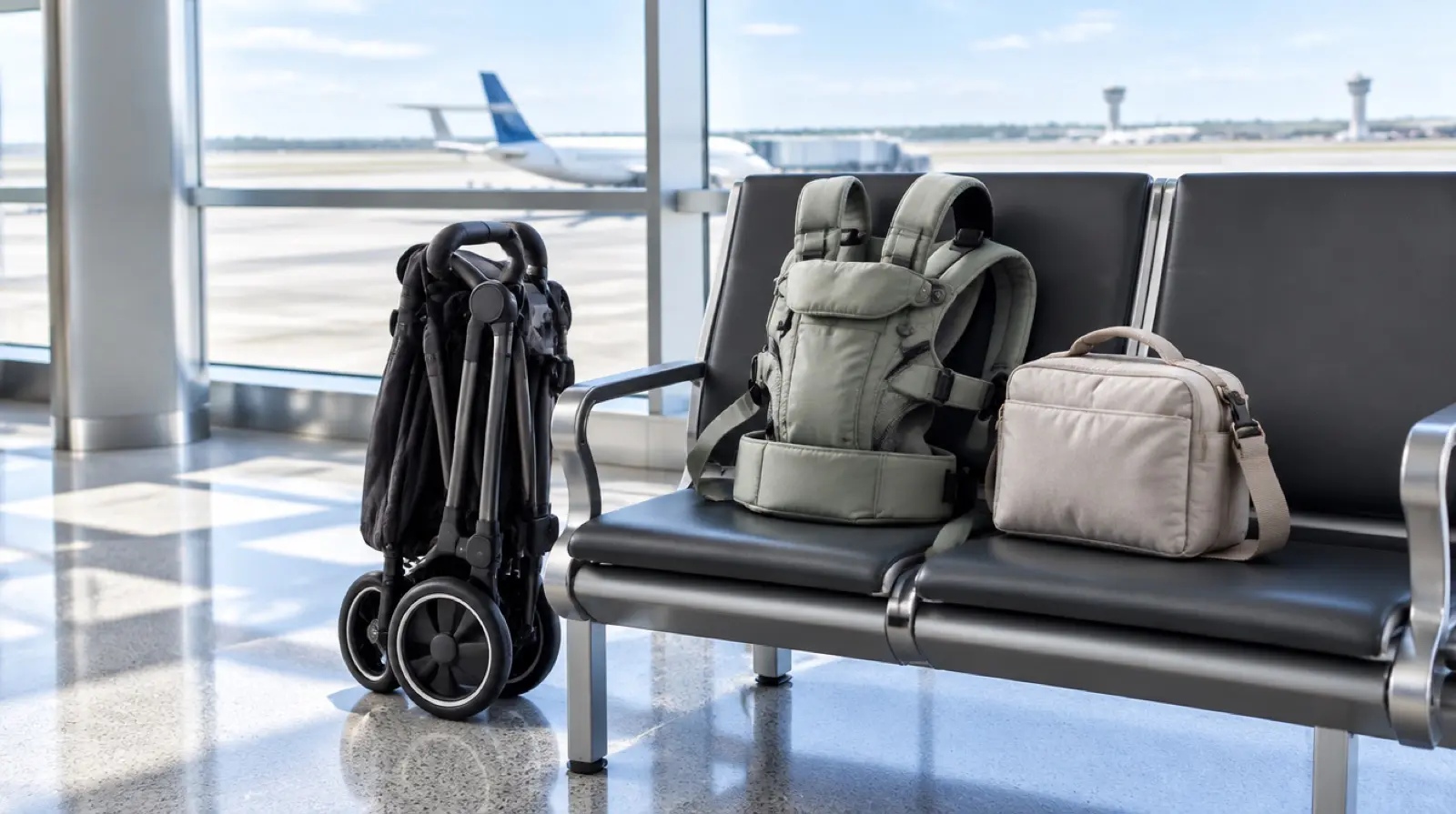
Flying with a baby goes best when you choose a nonstop flight timed around a nap, book a seat with extra floor space or a bassinet position, and carry twice the feeds and nappies you expect to use. Most airlines let babies under two travel on a lap, but a seat of their own is safer. Below is a planning method, a comparison table, seven decisions in order, and what to confirm with the airline.
How to plan flying with a baby: the method
A flight with a baby succeeds or fails on four things: the length of the longest leg, how well the departure time fits the sleep pattern, whether the baby has a safe place to rest, and how much margin you have between connections. Everything else is detail. Decide those four first, then work outward.

The planning order used here is simple. Pick the age band, because a three-month-old and a ten-month-old need different plans. Choose the flight pattern next. Choose the seat last. Then write down the feed, nap and nappy times you expect, so each block of the journey has an anchor that does not depend on the baby cooperating.
Age and stamina note: under about four months, babies sleep most of the flight and mostly need feeding and holding. From about six to nine months, they are awake, mobile and curious, and need a plan for movement. From about ten months, a baby who is crawling or pulling up will resist being held for hours, so the nap window matters more than the seat.
Flying with a baby at a glance: choices compared
| Decision | Easier option | Harder option | Deciding factor |
|---|---|---|---|
| Flight length | Under about 3 hours | Over 8 hours | Age and how the baby copes with confinement |
| Route | Nonstop | Tight connection | Margin of at least 90 minutes if you must connect |
| Departure time | Matches a main nap or bedtime | Early morning with a broken night | The baby’s usual sleep rhythm |
| Seat for the baby | Own seat with a restraint | Lap infant | Budget versus safety and comfort |
| Parent seats | Bulkhead, bassinet position or window plus aisle | Middle seat in a full row | Availability and airline policy |
| Luggage | Gate-checked stroller and one carry-on | Several bags and a carrier | Your hands needed for the baby |
| Arrival | Early evening, then straight to bed | Late night after a transfer | Transfer length at the other end |
Prices, allowances and policies vary by airline and route. Treat the table as a way to rank your options, and check the airline’s own family page before booking.
Seven decisions for flying with a baby, in order
1. Choose the flight length for the baby’s age
For a newborn, a long flight is often easier than for an older baby, because young babies sleep for much of it. The hard window is usually from about six months to a year, when babies are awake, active and want to move. For that age, a flight of two to four hours is a comfortable first test.
If you have no choice and the flight is long, plan the journey around sleep and accept that the day will be tiring. Many airlines set a minimum age for travel, often a week or two after birth, so check the rule for a very young baby.
2. Prefer nonstop, and plan layovers as a rest block
A nonstop flight removes the riskiest part of the journey: the connection. If a layover is unavoidable, a longer one is often kinder than a tight one, because you can feed, change and let the baby move without running. Aim for two to four hours, and avoid a stop that falls in the middle of the night. Check whether the airport has a family room or nursing area. Decision point: if the connection needs a terminal change, a security check or a passport control, choose a longer layover or a different route.
3. Time the departure around a nap
A flight that begins just before a main nap gives the baby the best chance of sleeping soon after takeoff. Early-morning flights save the day for the destination, but they often mean a broken night and a tired baby at the gate. A mid-morning or early-afternoon departure suits many routines. For a long overnight flight, move bedtime a little earlier in the days before, but do not change the whole schedule. Nap anchor: start the usual pre-sleep routine at the gate, and keep it short, with a feed and a quiet cuddle.
4. Decide between a lap seat and a seat of their own
On most airlines, a baby under two can travel on a parent’s lap, which is free or low cost on domestic flights and usually priced at a fraction of the adult fare internationally. Aviation safety regulators in several countries, including the US Federal Aviation Administration, recommend a child restraint in a purchased seat, because a lap baby is not secured in turbulence. A seat also gives the baby room to sleep. If you buy one, check that the car seat or harness has an approved label for aircraft, and that it fits the seat width.
5. Pick seats by what the row gives you
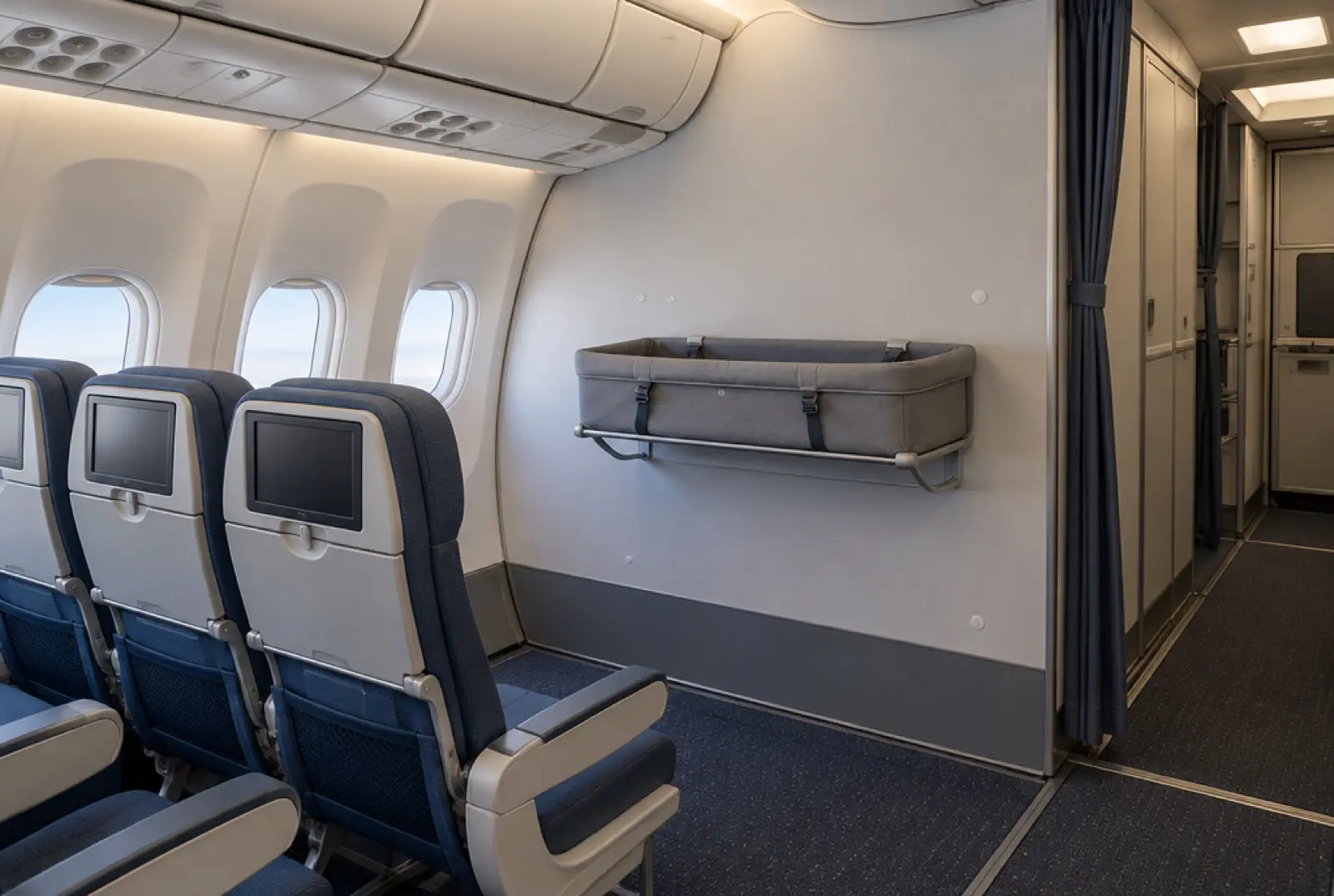
A bulkhead row gives floor space and, on many long-haul aircraft, a bassinet attachment for small babies, but the armrests are fixed and you cannot keep a bag at your feet. A window and aisle pair in a row of three often leaves the middle seat empty on quieter flights, so book that pair and wait. Bassinet positions are limited, tied to the baby’s weight and length, and often released only on request, so contact the airline soon after you book. Check the current weight limit on the airline’s page.
6. Plan the feed for takeoff and landing
Babies cannot equalise ear pressure on purpose, and sucking and swallowing help. Feed or offer a bottle, a dummy or a drink during climb and descent. The feed should start as the plane begins to descend, not when the seat-belt sign comes on, because the sign can arrive late.
Carry more milk, formula, water and food than you expect, since delays are common. Most security systems allow baby milk and formula above the usual liquid limit, but they screen it separately, so allow extra time and check the airport’s rules.
7. Pack for the worst hour, not the average one
Pack a change of clothes for the baby and a top for yourself, because spills and nappy leaks happen at altitude. Bring more nappies than the flight length suggests, a changing mat, wipes, bags for rubbish, a muslin, and two or three small toys the baby has not seen for a few days. A soft carrier lets you keep your hands free through the airport.
Gate-check the stroller, since most airlines carry it free, and use it to the aircraft door. Tired-day swap: if the baby is overtired at the gate, move to a quiet corner and give a feed before boarding, not on the plane.
Common mistakes when flying with a baby
- Booking a tight connection. A missed second flight with a baby is far harder than a longer wait. Add margin.
- Relying on a bassinet without confirming it. Ask the airline directly, and have a backup plan for holding the baby if it is not available.
- Waiting to feed until the cabin gets loud. Start before the descent begins.
- Overpacking the carry-on. A heavy bag leaves you without a free hand. Pack for the flight and the first day only.
- Skipping the documents. A baby needs a passport for international trips, and some countries ask for proof of the baby’s age or a parental consent letter when only one parent travels.
- Planning a big first day. Land, eat, sleep and plan nothing before the second morning.
Edge cases matter too. A baby with a cold or a recent ear infection may need a doctor’s advice before flying. Ask your health professional if you are unsure, and do not rely on a general article for that call.
What to verify before you rely on this advice
Airline rules change, and each carrier sets its own. Confirm these points on the airline’s official family travel page or by contacting it, and keep the answers with your booking.
- The minimum age for travel and any documentation for very young babies.
- The lap infant policy, the fee, and whether a seat is guaranteed.
- Bassinet availability, the weight and length limits, and which rows have fittings.
- Free baggage and stroller allowances for an infant.
- The rules on carrying baby milk, formula and food through security at both ends.
- Whether your car seat is approved for use on board, and its width.
- Passport and entry requirements for the baby, using the official government source.
Where to go next
Once the flight is sorted, choose a destination that keeps transfers short. For a warm-weather trip with a pool and short transfers, see the guide to family resorts in the Caribbean or family resorts in Mexico, which both start from flight and transfer time. For a long-haul trip, family resorts in Australia shows how to build a trip around the flight. If you want to compare packages with a self-planned route, read family vacation packages versus self-planned trips.
FAQ: flying with a baby
What is the best age to fly with a baby?
There is no single best age. Babies under about four months sleep for much of the flight and are easy to carry, but they are also more fragile and may fall under the airline’s minimum age. Many parents find a flight easier before the baby starts crawling. Ask your health professional about a very young baby, and check the airline’s rule.
Does a baby need their own seat on a plane?
Not required on most airlines for a baby under two, who can sit on a lap. However, safety regulators such as the US Federal Aviation Administration recommend a restraint system in a paid seat, and the extra space helps with sleep. The cost may be high on international routes, so compare the fare with the benefit and check the airline’s policy.
How do you help a baby’s ears on a plane?
Offer a feed, a bottle or a dummy during takeoff and especially descent, since sucking and swallowing help equalise pressure. Start as the aircraft begins to descend. If the baby is asleep, many parents wake them gently for a feed, though some leave a sleeping baby. If a cold or ear infection is present, ask a doctor before you fly.
Can you take baby milk and formula through airport security?
In most countries, baby milk, formula and food are allowed above the usual liquid limit in reasonable quantities, but they may be screened separately and opened for testing. Allow extra time at the checkpoint. Carry more than the flight needs, in case of delay, and check the security rules at each airport on your route, since they differ.
Is a long-haul flight with a baby a bad idea?
No, but it takes planning. A flight of ten hours or more is doable with a bassinet seat, an overnight departure that matches bedtime, and plenty of feeds and nappies. Expect a tired first day, and do not plan activities for it. If the baby is between about six and twelve months, consider a break in the journey.